
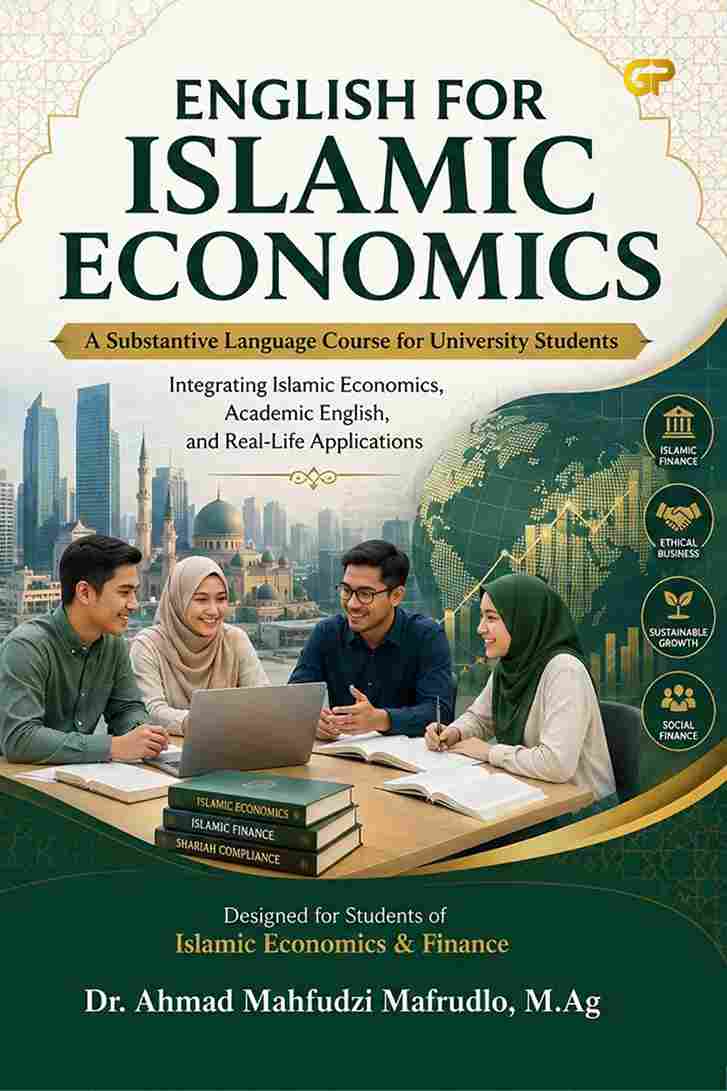
This textbook is designed for students of Islamic Economics, Sharia Finance, and related disciplines who seek to enhance their academic English proficiency while simultaneously deepening their understanding of Islamic economic principles. It integrates language learning with substantive academic content, ensuring that students develop both linguistic competence and conceptual mastery within a meaningful intellectual framework.
Unlike conventional English as a Second Language (ESL) materials, this book situates learning within the context of Islamic finance and economics. It provides authentic academic exposure by embedding language practice in discussions that reflect real-world issues, theoretical debates, and professional practices in the field. This approach allows learners to engage with English not merely as a language system, but as a medium of scholarly and ethical discourse.
Each chapter is structured around authentic dialogues involving students, lecturers, and practitioners in Islamic economics. These dialogues are followed by systematic learning components, including vocabulary enrichment, pronunciation exercises using the International Phonetic Alphabet (IPA), grammar focus sections, guided discussion questions, and structured writing tasks. This design supports the gradual development of integrated language skills in an academic context.
Overall, the textbook emphasizes both linguistic development and intellectual engagement. It encourages learners to critically reflect on values such as justice, equity, and ethical responsibility in economic practice, while simultaneously strengthening their ability to communicate effectively in academic English. In this way, the book serves as both a language learning resource and a medium for cultivating informed and principled engagement with Islamic economic thought.





Ulasan
Belum ada ulasan.